Integrative Medicine Certification for Physician Assistants is becoming an increasingly interesting educational option for PAs who want to expand their knowledge of whole-person care, lifestyle factors, nutrition, preventive health, and evidence-informed complementary approaches.
Physician assistants already receive broad clinical training, and additional education in integrative medicine can help them better understand how lifestyle, behavior, patient preferences, and complementary health approaches may fit into a comprehensive care plan.
However, choosing an integrative medicine certification program requires careful research. Not every online course or certificate has the same educational value, professional recognition, or clinical relevance.
This guide explains what integrative medicine certification means for physician assistants, what these programs may teach, how online education works, and what PAs should consider before enrolling.
 What Is Integrative Medicine Certification for Physician Assistants?
Integrative medicine certification generally refers to additional education or professional training focused on whole-person healthcare and evidence-informed complementary approaches.
For physician assistants, this type of education may complement their existing clinical training.
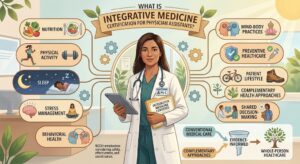
Integrative medicine commonly considers multiple dimensions of health, including:
- Nutrition
- Physical activity
- Sleep
- Stress management
- Behavioral health
- Mind-body practices
- Preventive healthcare
- Patient lifestyle
- Complementary health approaches
- Shared decision-making
The goal is not necessarily to replace conventional medical care. Instead, integrative healthcare generally seeks to combine appropriate conventional care with complementary approaches when supported by evidence and when they fit the patient’s needs.
The National Center for Complementary and Integrative Health (NCCIH) emphasizes that evidence varies among complementary approaches and encourages patients and healthcare professionals to consider safety, effectiveness, and coordination with conventional care. (Integrative medicine certification for physician assistants)
Why Would a Physician Assistant Study Integrative Medicine?
PAs work in many healthcare environments, including primary care, family medicine, internal medicine, specialty clinics, hospitals, and outpatient settings.
Additional education in integrative medicine may help a PA develop a broader perspective on patient care.
1. Expand Knowledge of Whole-Person Care
Traditional clinical training focuses heavily on diagnosis, treatment, pharmacology, procedures, and disease management.
Integrative medicine education can add another perspective by exploring how lifestyle and behavioral factors may influence overall health.
2. Improve Patient Conversations
Patients frequently have questions about supplements, nutrition, meditation, exercise, sleep, or other complementary approaches.
A PA with additional training may be better prepared to have informed conversations about these subjects.
3. Understand Complementary Health Approaches
Some patients use complementary approaches alongside conventional treatment.
Understanding what patients are using can help healthcare professionals identify possible safety issues and encourage communication between different members of the healthcare team. (Integrative medicine certification for physician assistants)
4. Develop Preventive Health Skills
Many integrative programs emphasize prevention and healthy lifestyle behaviors.
This may be particularly relevant for PAs working in primary care or other settings where preventive health counseling is an important part of patient care.
 What Do Integrative Medicine Certification Programs Teach?
Curricula vary substantially between programs, so prospective students should carefully examine the actual course content.
Common subjects may include the following.
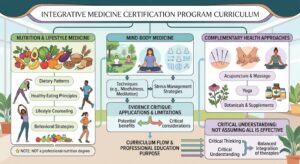
Nutrition and Lifestyle Medicine
Nutrition is often an important component of integrative health education.
Courses may introduce dietary patterns, healthy eating principles, lifestyle counseling, physical activity, and behavioral strategies.
However, a short certification course should not be confused with a professional nutrition degree or specialty license. (Integrative medicine certification for physician assistants)
Mind-Body Medicine
Students may learn about approaches such as mindfulness, meditation, relaxation techniques, breathing exercises, and stress-management strategies.
The strongest programs should explain both potential applications and limitations of the evidence.
Complementary Health Approaches
Programs may introduce topics involving acupuncture, massage, yoga, botanical products, dietary supplements, or other complementary practices.
The purpose of professional education should be to understand these approaches critically rather than assume that every natural or complementary intervention is effective.
Evidence-Based Practice
Evidence evaluation is particularly important.
PAs should be able to distinguish between:
- Strong clinical evidence
- Preliminary research
- Observational findings
- Traditional use
- Expert opinion
- Marketing claims
NCCIH provides evidence-based resources, research information, literature reviews, and clinical resources that healthcare professionals can use when evaluating complementary health approaches. (Integrative medicine certification for physician assistants)
Patient-Centered Care
Integrative medicine education may also emphasize communication, shared decision-making, patient preferences, and individualized care.
These concepts can complement the PA’s existing clinical responsibilities.
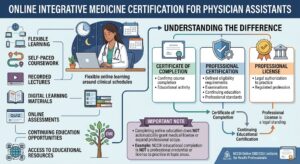 Online Integrative Medicine Certification for Physician Assistants
Online education can be attractive to working PAs because it may provide greater flexibility than traditional classroom programs.
An online program may allow students to study around existing clinical schedules.
Potential benefits include:
- Flexible learning
- Self-paced coursework
- Recorded lectures
- Digital learning materials
- Online assessments
- Continuing education opportunities
- Access to educational resources from different institutions
NCCIH currently provides online continuing education lectures on complementary and integrative health topics. Its online series is designed for physicians, nurses, and other allied health professionals, and qualifying activities can offer CME or CEU credit and certificates of completion.
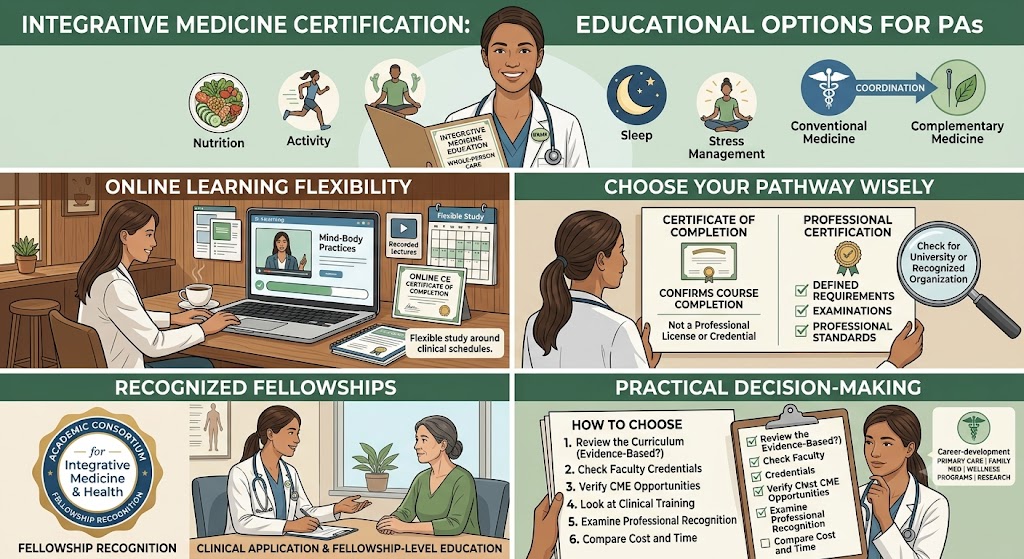
However, PAs should carefully distinguish an online certificate of completion from a professional certification or clinical credential.
For example, completing an online educational activity does not automatically grant a medical license or authorize someone to practice outside their existing professional scope. NCCIH specifically notes that completion of its educational program does not represent a professional medical license, credential, or certification to practice in the topic areas covered. (Integrative medicine certification for physician assistants)
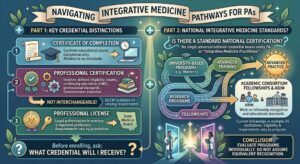 Certification vs. Certificate of Completion
This distinction is one of the most important things physician assistants should understand.
A certificate of completion usually confirms that a person completed an educational course.
A professional certification may involve defined eligibility requirements, examinations, continuing education, or other professional standards.
A professional license is a legal authorization to practice a regulated profession.
These terms should not be treated as interchangeable.
NCCIH explains that credentialing and licensing requirements can vary by profession and jurisdiction. It also distinguishes credentials such as licenses, certificates, and educational qualifications.
Before enrolling, ask the program exactly what credential you will receive after completion.
Is There a Standard National Integrative Medicine Certification for PAs?
There is not one universal national credential that automatically makes every physician assistant an “integrative medicine practitioner.”
Integrative medicine education is offered through different institutions and educational pathways.
Some opportunities involve continuing education, while others may involve university-based programs, advanced training, research programs, or fellowships.
The Academic Consortium for Integrative Medicine & Health maintains recognized integrative medicine fellowship programs and works with the American Board of Integrative Medicine on fellowship recognition and educational standards.
Its current fellowship listings include programs across multiple U.S. institutions, although eligibility and professional requirements vary by program.
Therefore, physician assistants should evaluate each program individually rather than assuming that every program called an “integrative medicine certification” has equivalent recognition.
How to Choose the Best Integrative Medicine Certification for Physician Assistants
If you are comparing programs, consider these factors.
1. Review the Curriculum
Look for a curriculum that covers both integrative approaches and evidence evaluation.
A strong program should not simply list alternative therapies. It should explain what is known, what remains uncertain, and what safety issues need to be considered.
2. Check the Faculty
Look at the professional backgrounds of instructors.
Faculty may include physicians, PAs, nurses, researchers, nutrition professionals, psychologists, or other healthcare professionals.
3. Verify CME or CE Opportunities
If continuing education credit is important to you, verify exactly which organization provides the credit and whether it is applicable to your professional requirements.
Do not assume that every certificate automatically qualifies as professional continuing education. (Integrative medicine certification for physician assistants)
4. Look at Clinical Training
Some programs are primarily educational and online.
Others may include clinical experiences, supervised training, or fellowship-level education.
If your objective involves clinical application, determine how much supervised education is actually included.
5. Examine Professional Recognition
Investigate whether the program is offered through an established academic institution or recognized professional organization.
Also determine whether the credential is actually relevant to your PA career goals.
6. Compare Cost and Time Commitment
Consider:
- Tuition
- Registration fees
- Required textbooks
- Examination fees
- Travel requirements
- Clinical requirements
- Program duration
- CME fees
The cheapest program is not necessarily the best value. (Integrative medicine certification for physician assistants)
How Can Integrative Medicine Training Help a PA Career?
Additional education may be particularly relevant for PAs interested in:
- Primary care
- Family medicine
- Preventive healthcare
- Lifestyle-focused care
- Wellness programs
- Integrative health clinics
- Patient education
- Community health
- Research
- Health coaching environments
- Interdisciplinary healthcare
However, additional integrative medicine education does not replace the PA’s foundational professional education or existing clinical credentials.
Instead, it can function as an additional area of knowledge.
NCCIH also supports research training and career-development opportunities related to complementary and integrative health, including opportunities intended to strengthen research skills and interdisciplinary collaboration.
Books and Resources for Physician Assistants
Formal coursework is only one way to learn about integrative medicine.
Books can provide additional background on nutrition, lifestyle medicine, mind-body approaches, preventive health, and evidence-based complementary medicine.
When selecting educational books, look for resources written or reviewed by appropriately qualified healthcare professionals and prioritize materials that clearly distinguish scientific evidence from unproven claims.
Recommended Integrative Medicine Resource
You can place your Amazon affiliate link here for a relevant integrative medicine, lifestyle medicine, nutrition, or healthcare education book.
Affiliate Disclosure: This website may earn a commission from qualifying purchases made through affiliate links, at no additional cost to you. (Integrative medicine certification for physician assistants)
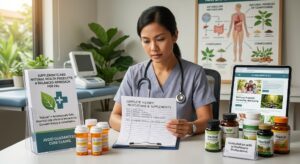 Supplements and Natural Health Products
Integrative medicine education may also discuss dietary supplements and natural products.
Physician assistants should approach these products carefully.
“Natural” does not automatically mean safe, effective, or appropriate for every patient. Supplements can have potential side effects and interactions with medications.
For this reason, healthcare professionals should consider a patient’s complete medication and supplement history and encourage appropriate clinical consultation.
If you promote a consumer wellness product on your website, avoid presenting it as a guaranteed treatment or cure for a medical condition.
Affiliate Disclosure: We may receive a commission if you purchase through an affiliate link. Product information is provided for general educational purposes and is not a substitute for professional medical advice.
Questions to Ask Before Enrolling
Before paying for an integrative medicine certification program, physician assistants should ask:
- Is the program designed specifically for healthcare professionals?
- Are physician assistants eligible?
- Who teaches the program?
- What qualifications do instructors have?
- What exactly is awarded upon completion?
- Is the credential a certificate or professional certification?
- Are CME or CE credits available?
- Who accredits or recognizes the program?
- Does the program include clinical training?
- How long does completion take?
- What is the total cost?
- Can the training support my professional goals?
These questions can help prevent confusion between general education and professional credentials.
Frequently Asked Questions
What is integrative medicine certification for physician assistants?
It is additional education focused on whole-person healthcare, lifestyle factors, complementary health approaches, and evidence-informed patient care. The exact credential and professional recognition depend on the program.
Can physician assistants study integrative medicine online?
Yes. Online courses and continuing education opportunities are available for healthcare professionals. However, online education varies significantly in depth, accreditation, clinical training, and professional recognition. (Integrative medicine certification for physician assistants)
Does an integrative medicine certificate make a PA an integrative medicine specialist?
Not automatically. A certificate of completion may demonstrate additional education, but it should not be assumed to create a new professional license or specialty credential.
Can PAs earn CME through integrative medicine courses?
Some educational activities offer CME or other continuing education credits. PAs should verify the specific activity and whether the credit meets their professional requirements.
Is integrative medicine evidence-based?
Evidence varies by intervention. Some complementary approaches have research supporting particular uses, while evidence for others remains limited or uncertain. Healthcare professionals should evaluate evidence, safety, risks, and patient circumstances before incorporating an approach into care.
Final Thoughts
Integrative Medicine Certification for Physician Assistants can be a valuable educational pathway for PAs who want to broaden their knowledge of whole-person care, lifestyle medicine, nutrition, prevention, and complementary health approaches.
The key is choosing education based on quality rather than marketing claims.
Look for programs with qualified faculty, transparent curricula, evidence-based teaching, appropriate professional recognition, and clearly defined credentials. If CME or CE credit matters to you, verify the details before enrolling.
Most importantly, remember that integrative medicine should complement appropriate conventional healthcare rather than encourage patients to abandon proven medical treatment.
For physician assistants, the best integrative medicine education is education that strengthens clinical knowledge, supports thoughtful patient communication, and encourages safe, evidence-informed decision-making.
Medical Disclaimer
This article is intended for educational and informational purposes only. It does not provide medical advice, diagnosis, or treatment and does not establish any professional credential or license. Healthcare professionals should follow applicable laws, professional standards, institutional policies, and scope-of-practice requirements. Patients should consult qualified healthcare professionals regarding individual medical decisions.
Affiliate Disclosure
This article may contain affiliate links. If you purchase a product through an affiliate link, HolisticFamilyMed.com may receive a commission at no additional cost to you. Affiliate relationships do not determine the educational or health information presented in this article.