When exploring healthcare options, people often encounter the terms “conventional medicine” and “integrative medicine.” Understanding the differences between these two approaches can facilitate communication with healthcare professionals and help you evaluate various options for supporting your health and well-being.
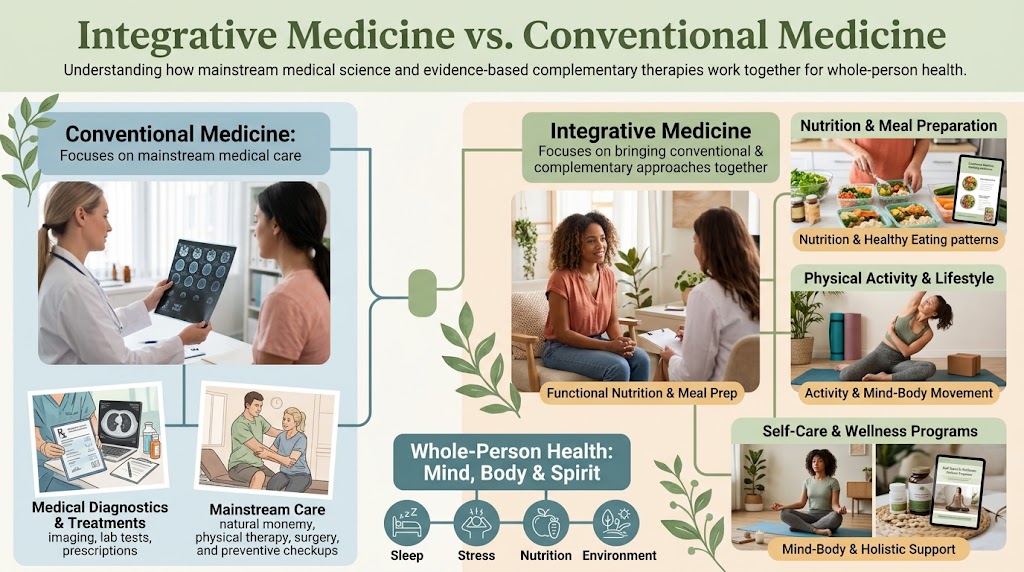
Conventional medicine generally refers to mainstream medical care, encompassing methods such as prescription medications, surgery, diagnostic testing, physical rehabilitation, and psychotherapy. Integrative medicine takes a broader approach by coordinating conventional and complementary methods.
According to the National Center for Complementary and Integrative Health (NCCIH), integrative medicine combines conventional and complementary approaches while emphasizing holistic care for the individual.
It is important to note that integrative medicine does not necessarily mean replacing conventional medicine. In fact, complementary approaches are often distinguished from alternative therapies because they are used alongside—rather than in place of—conventional medicine.
What is conventional medicine?
Conventional medicine is the healthcare system most commonly practiced by licensed physicians, nurses, pharmacists, therapists, and other healthcare professionals.
It relies heavily on scientific research, clinical training, diagnostic testing, established treatment protocols, and evidence-based interventions. Some examples of traditional health care include:
- Prescription drugs
- Over-the-counter medications
- Vaccinations
- Laboratory testing
- Medical imaging
- Surgery
- Physical therapy
- Psychotherapy
- Emergency medical care
- Preventive screenings
- Routine medical examinations
Conventional medicine can be especially important when someone has an acute illness, serious injury, infection, or condition requiring urgent diagnosis and treatment.
It also plays an important role in preventive healthcare, chronic disease management, and monitoring health risks.
 What Is Integrative Medicine?
Integrative medicine brings conventional healthcare and selected complementary approaches together in a coordinated manner.
NCCIH describes integrative health as combining conventional and complementary approaches with an emphasis on whole-person care and coordination among providers.
An integrative healthcare plan might therefore include conventional medical treatment together with appropriate approaches such as:
- Nutrition counseling
- Meditation
- Yoga
- Acupuncture
- Massage therapy
- Mindfulness
- Physical activity
- Relaxation techniques
- Certain dietary approaches
- Selected supplements when appropriate
The specific approaches used depend on the individual’s health needs, goals, medical history, and available evidence.
The goal is not simply to use as many treatments as possible. Instead, the focus should be on selecting appropriate approaches and coordinating care safely.
Integrative Medicine vs Conventional Medicine: The Main Difference
The key distinction in integrative medicine vs conventional medicine is the range of approaches considered within the healthcare plan.
Conventional Medicine
Conventional medicine primarily uses established medical approaches such as:
- Medication
- Surgery
- Diagnostic testing
- Rehabilitation
- Psychotherapy
- Preventive care
Integrative Medicine
Integrative medicine may use conventional medical care while also considering appropriate complementary approaches.
For example, a person receiving conventional care for a health condition may also work with qualified professionals on nutrition, physical activity, stress management, or another complementary practice.
NCCIH emphasizes that integrative health aims to bring conventional and complementary approaches together in a coordinated way.
This means the two approaches do not necessarily have to compete with each other.
 What Does Whole-Person Health Mean?
Whole-person health is an important concept within modern integrative healthcare.
Rather than viewing the body as a collection of completely separate systems, whole-person health considers interconnected biological, behavioral, social, and environmental factors.
NCCIH explains that whole-person health looks beyond individual diseases and considers multiple interconnected areas that may influence health and well-being.
These areas can include:
- Nutrition
- Physical activity
- Sleep
- Stress
- Relationships
- Environment
- Behaviors
- Emotional well-being
- Social circumstances
This broader perspective can help healthcare professionals understand factors that may influence a person’s overall health.
Common Integrative Medicine Approaches
Integrative medicine can include a variety of complementary approaches.
Nutrition
Nutrition counseling may focus on building sustainable eating habits and understanding an individual’s nutritional needs.
A balanced eating pattern may include vegetables, fruits, whole grains, legumes, nuts, seeds, healthy fats, and appropriate sources of protein.
Nutrition recommendations should be individualized when someone has a specific medical condition.
Mindfulness and Meditation
Meditation and mindfulness practices are commonly discussed as complementary approaches.
They may involve focused attention, breathing, relaxation, and awareness of thoughts or sensations.
Yoga and Tai Chi
Yoga and tai chi combine physical movement with elements of breathing, concentration, and body awareness.
The appropriate activity depends on a person’s fitness level, medical conditions, and physical limitations.
Acupuncture
Acupuncture is another complementary approach studied within integrative health research.
People considering acupuncture should seek an appropriately qualified practitioner and discuss it with their healthcare team when relevant.
Massage Therapy
Massage therapy may be incorporated into some integrative health programs, depending on the person’s needs and circumstances.
NCCIH identifies massage, acupuncture, meditation, yoga, and tai chi among complementary approaches studied in this field.
 Nutrition and Integrative Healthcare
Nutrition is often an important part of whole-person healthcare.
A healthcare professional may discuss:
- Eating patterns
- Meal planning
- Food preferences
- Nutrient intake
- Portion awareness
- Hydration
- Sustainable lifestyle habits
Rather than relying on one “superfood,” a healthy eating pattern generally focuses on a variety of nutritious foods.
Amazon Affiliate Recommendation
This section is a natural place to recommend a practical product related to healthy meal preparation.
Shop Recommended Meal-Prep Containers on Amazon
You can replace this placeholder with a relevant Amazon Associates product link. The product should be presented as a kitchen or meal-preparation tool, not as a treatment for disease.
Physical Activity and Lifestyle
Lifestyle habits are another important part of whole-person health.
Depending on an individual’s circumstances, physical activity may include:
- Walking
- Swimming
- Cycling
- Strength training
- Stretching
- Yoga
- Tai chi
- Recreational activities
A realistic approach is usually more sustainable than making dramatic changes overnight.
People with medical conditions, injuries, or significant physical limitations should discuss appropriate activity levels with a qualified healthcare professional.
Amazon Affiliate Recommendation
You can place a second relevant Amazon recommendation here:
View Recommended Home Wellness or Exercise Products on Amazon
Choose products that are genuinely relevant to the section and avoid making unsupported medical claims.
 Supplements and Natural Products
Some people interested in integrative medicine also explore dietary supplements, including:
- Vitamins
- Minerals
- Herbs
- Botanical products
- Probiotics
However, supplements should be approached carefully.
The word “natural” does not automatically mean that a product is safe or effective. Some supplements can cause side effects or interact with medications.
NCCIH recommends researching the safety and effectiveness of complementary health approaches and discussing supplements with healthcare professionals.
Anyone taking prescription medications should tell their healthcare providers about supplements they are considering or already using.
ClickBank Affiliate Recommendation
If you have a relevant wellness or educational product on ClickBank, you can place a contextual recommendation in this section:
The offer should be relevant to the article and described accurately. Avoid products that claim to cure, reverse, or prevent serious diseases without strong scientific evidence.
Potential Benefits of Integrative Medicine
An integrative approach may offer several potential advantages when properly coordinated.
Whole-Person Perspective
Instead of focusing only on a diagnosis, healthcare can consider multiple factors that influence health.
Lifestyle Support
Nutrition, sleep, movement, and stress management can become part of the healthcare conversation.
Coordinated Care
Conventional and complementary professionals may communicate when appropriate.
Personalized Healthcare
Healthcare recommendations can be adapted to individual circumstances and preferences.
Patient Engagement
Patients can become more involved in understanding their options and participating in healthcare decisions.
NCCIH describes integrative health as aiming for well-coordinated care among providers and institutions while bringing conventional and complementary approaches together.
Potential Benefits of Conventional Medicine
Conventional medicine also provides important advantages.
Strong Diagnostic Infrastructure
Modern healthcare offers laboratory testing, imaging, physical examinations, and other diagnostic tools.
Emergency Treatment
Hospitals and emergency departments can provide rapid treatment for serious injuries and acute medical problems.
Prescription Therapies
Many medical conditions can be treated or managed using medications supported by extensive research.
Surgery
Surgical procedures can be essential for certain injuries and medical conditions.
Preventive Care
Vaccinations, screenings, checkups, and risk assessments can help identify and address health concerns.
For these reasons, integrative healthcare should not be viewed as automatically superior to conventional medicine.
The two approaches can sometimes complement one another.
Is Integrative Medicine Better Than Conventional Medicine?
There is no universal answer.
Phương pháp tiếp cận tốt nhất phụ thuộc vào nhu cầu sức khỏe cá nhân của người bệnh và liệu pháp cụ thể đang được xem xét.
Ví dụ, một người đang gặp trường hợp cấp cứu y tế cần được chăm sóc y tế khẩn cấp thích hợp thay vì trì hoãn điều trị trong khi thử một phương pháp bổ sung chưa được chứng minh hiệu quả.
Mặt khác, người quan tâm đến sức khỏe tổng quát có thể thảo luận về dinh dưỡng, hoạt động thể chất, giấc ngủ, quản lý căng thẳng và các yếu tố lối sống khác với chuyên gia chăm sóc sức khỏe của họ. (y học tích hợp so với y học truyền thống)
Câu hỏi quan trọng không chỉ đơn thuần là liệu y học tích hợp hay y học truyền thống tốt hơn.
Thay vào đó, hãy hỏi xem một phương pháp điều trị cụ thể có phải là:
- Phù hợp
- An toàn
- Dựa trên bằng chứng
- Được cung cấp bởi một chuyên gia có trình độ.
- Tương thích với các phương pháp điều trị khác
- Phù hợp với hoàn cảnh cá nhân
Tại sao bằng chứng lại quan trọng
Một trong những yếu tố quan trọng nhất cần xem xét khi so sánh y học tích hợp với y học truyền thống là bằng chứng khoa học.
Các liệu pháp khác nhau có mức độ nghiên cứu hỗ trợ hiệu quả và độ an toàn khác nhau.
Sứ mệnh của NCCIH bao gồm tiến hành nghiên cứu khoa học nghiêm túc về tính hữu ích và an toàn của các phương pháp chăm sóc sức khỏe bổ sung và tích hợp.
Trước khi thử bất kỳ liệu pháp bổ sung nào, hãy cân nhắc hỏi những câu sau:
- Nghiên cứu cho thấy điều gì?
- Những lợi ích tiềm năng là gì?
- Những rủi ro tiềm ẩn là gì?
- Liệu nó có thể tương tác với thuốc khác không?
- Ai đủ điều kiện để cung cấp dịch vụ đó?
- Liệu phương pháp này có phù hợp với tình trạng sức khỏe của tôi không?
NCCIH khuyến nghị nên là người tiêu dùng có hiểu biết và thảo luận về các phương pháp bổ sung với các nhà cung cấp dịch vụ chăm sóc sức khỏe trước khi đưa ra quyết định. (y học tích hợp so với y học truyền thống)
Y học tích hợp và quản lý bệnh mãn tính
Những người đang phải đối mặt với các vấn đề sức khỏe lâu dài có thể tiếp cận với các phương pháp chăm sóc sức khỏe tích hợp.
Một kế hoạch toàn diện có thể bao gồm điều trị y tế thông thường kết hợp với hỗ trợ lối sống phù hợp.
Ví dụ, một nhóm chăm sóc sức khỏe có thể thảo luận về:
- Dinh dưỡng
- Hoạt động thể chất
- Ngủ
- Nhấn mạnh
- Tuân thủ dùng thuốc
- Chăm sóc phòng ngừa
- Phục hồi chức năng
- Sức khỏe tinh thần và cảm xúc
Những yếu tố này nên bổ sung cho phương pháp điều trị y tế thích hợp chứ không phải thay thế việc chăm sóc cần thiết.
Khung đánh giá toàn diện của NCCIH đặc biệt xem xét các yếu tố sinh học, hành vi, xã hội và môi trường có thể tương tác với sức khỏe theo thời gian.
Cách lựa chọn giữa chăm sóc sức khỏe tích hợp và chăm sóc sức khỏe truyền thống
Bạn không nhất thiết phải chọn duy nhất một phương pháp.
Một chiến lược thiết thực là bắt đầu bằng việc đánh giá y tế thích hợp, sau đó thảo luận xem các phương pháp bổ sung có thể phù hợp một cách an toàn với kế hoạch chăm sóc sức khỏe tổng thể của bạn hay không.
Khi đánh giá nhà cung cấp dịch vụ, hãy cân nhắc:
Thông tin xác thực
Kiểm tra trình độ học vấn, giấy phép hành nghề, chứng chỉ và kinh nghiệm.
Chứng cớ
Hãy hỏi xem nghiên cứu nào hỗ trợ cho liệu pháp được đề xuất.
Giao tiếp
Hãy lựa chọn những chuyên gia sẵn sàng giao tiếp với các thành viên khác trong nhóm chăm sóc sức khỏe của bạn.
Sự an toàn
Thảo luận về thuốc, thực phẩm chức năng, dị ứng, bệnh lý và các tương tác thuốc có thể xảy ra.
Tính minh bạch
Hãy thận trọng với những nhà cung cấp hứa hẹn chữa khỏi hoàn toàn hoặc mang lại kết quả phi thường.
NCCIH khuyến cáo nên lựa chọn các chuyên gia y học bổ sung một cách cẩn thận và thông báo cho cả các nhà cung cấp dịch vụ y tế truyền thống và bổ sung về các phương pháp chăm sóc sức khỏe mà bạn đang sử dụng. (y học tích hợp so với y học truyền thống)
Y học tích hợp so với Y học truyền thống: So sánh nhanh
| Tính năng | Y học truyền thống | Y học tích hợp |
|---|---|---|
| Trọng tâm chính | Chẩn đoán và điều trị | Chăm sóc toàn diện cho con người |
| Xét nghiệm y tế | Chung | Có thể bao gồm |
| Thuốc theo toa | Chung | Có thể bao gồm |
| Ca phẫu thuật | Có sẵn khi được chỉ định. | Có sẵn khi được chỉ định. |
| Các yếu tố lối sống | Có thể được giải quyết | Thường được nhấn mạnh |
| Các phương pháp bổ sung | Thường là riêng biệt | Có thể được phối hợp |
| Dinh dưỡng | Có thể bao gồm | Thường được thảo luận |
| thực hành tâm-thân | Có thể riêng biệt | Có thể được kết hợp |
| Điều phối nhà cung cấp | Tùy thuộc vào từng trường hợp | Nhấn mạnh mạnh mẽ |
Sự so sánh này được đơn giản hóa vì các phương pháp chăm sóc sức khỏe khác nhau giữa các nhà cung cấp và hệ thống chăm sóc sức khỏe.
Câu hỏi thường gặp
Y học tích hợp và y học truyền thống khác nhau ở điểm nào?
Y học truyền thống chủ yếu sử dụng các phương pháp y học chính thống như thuốc men, phẫu thuật, xét nghiệm chẩn đoán, phục hồi chức năng và tâm lý trị liệu. Y học tích hợp kết hợp chăm sóc truyền thống phù hợp với các phương pháp bổ sung được lựa chọn một cách phối hợp.
Liệu y học tích hợp có thay thế y học truyền thống?
Không. Y học tích hợp nói chung nhằm mục đích kết hợp các phương pháp điều trị truyền thống và bổ sung chứ không phải thay thế các phương pháp chăm sóc sức khỏe truyền thống cần thiết.
Y học tích hợp có dựa trên bằng chứng khoa học không?
Mỗi liệu pháp riêng lẻ có mức độ bằng chứng khác nhau. Mỗi phương pháp cần được đánh giá dựa trên các nghiên cứu hiện có, lợi ích tiềm năng và độ an toàn. (y học tích hợp so với y học truyền thống)
Liệu thực phẩm chức năng có thể là một phần của y học tích hợp?
Một số thực phẩm chức năng có thể được coi là phương pháp hỗ trợ. Tuy nhiên, thực phẩm chức năng có thể gây ra tác dụng phụ và tương tác với thuốc, vì vậy cần thảo luận với chuyên gia chăm sóc sức khỏe có trình độ.
Y học tích hợp là một ví dụ?
Ví dụ có thể bao gồm chăm sóc sức khỏe truyền thống kết hợp với tư vấn dinh dưỡng phù hợp, thiền định, yoga, châm cứu, liệu pháp xoa bóp, hoạt động thể chất hoặc các phương pháp bổ sung khác.
Y học truyền thống còn giữ vai trò quan trọng trong chăm sóc sức khỏe tích hợp không?
Đúng vậy. Chẩn đoán chính xác theo phương pháp thông thường, chăm sóc phòng ngừa, thuốc men, phẫu thuật, phục hồi chức năng và điều trị cấp cứu vẫn là những thành phần quan trọng của chăm sóc sức khỏe hiện đại.
Lời kết
Hiểu về y học tích hợp so với y học truyền thống không nhất thiết phải đồng nghĩa với việc lựa chọn một triết lý chăm sóc sức khỏe này hay triết lý kia.
Y học truyền thống cung cấp các dịch vụ chẩn đoán, phòng ngừa, cấp cứu, dược phẩm, phẫu thuật và phục hồi chức năng thiết yếu. Y học tích hợp mở rộng phạm vi thảo luận bằng cách phối hợp các phương pháp bổ sung phù hợp với chăm sóc sức khỏe truyền thống và nhấn mạnh đến toàn bộ con người.
Cách tiếp cận có trách nhiệm nhất là tập trung vào bằng chứng, sự an toàn, trình độ chuyên môn, giao tiếp và nhu cầu cá nhân .
Dinh dưỡng, hoạt động thể chất, giấc ngủ, quản lý căng thẳng, chánh niệm và một số phương pháp bổ sung khác đều có thể đóng vai trò trong chiến lược chăm sóc sức khỏe toàn diện hơn khi chúng phù hợp với từng cá nhân.
Nếu bạn đang cân nhắc một liệu pháp mới, thực phẩm bổ sung hoặc thay đổi lối sống đáng kể, hãy thảo luận với chuyên gia chăm sóc sức khỏe có trình độ. Không nên ngừng thuốc theo toa hoặc trì hoãn điều trị y tế cần thiết chỉ vì một phương pháp bổ sung chưa được chứng minh hiệu quả. (y học tích hợp so với y học truyền thống)
Thông báo về liên kết tiếp thị: Một số liên kết trong bài viết này có thể là liên kết tiếp thị. Nếu bạn mua hàng thông qua liên kết tiếp thị, Holistic Family Med có thể nhận được hoa hồng mà không phát sinh thêm chi phí nào cho bạn. Mối quan hệ tiếp thị liên kết không quyết định nội dung thông tin giáo dục được trình bày trong bài viết này.
Tuyên bố miễn trừ trách nhiệm y tế: Bài viết này chỉ nhằm mục đích giáo dục và cung cấp thông tin chung. Nó không thay thế cho lời khuyên, chẩn đoán hoặc điều trị y tế chuyên nghiệp. Luôn luôn tham khảo ý kiến chuyên gia chăm sóc sức khỏe có trình độ phù hợp về nhu cầu sức khỏe cá nhân của bạn.
1 thought on “Integrative Medicine vs Conventional Medicine: Key Differences Explained”